
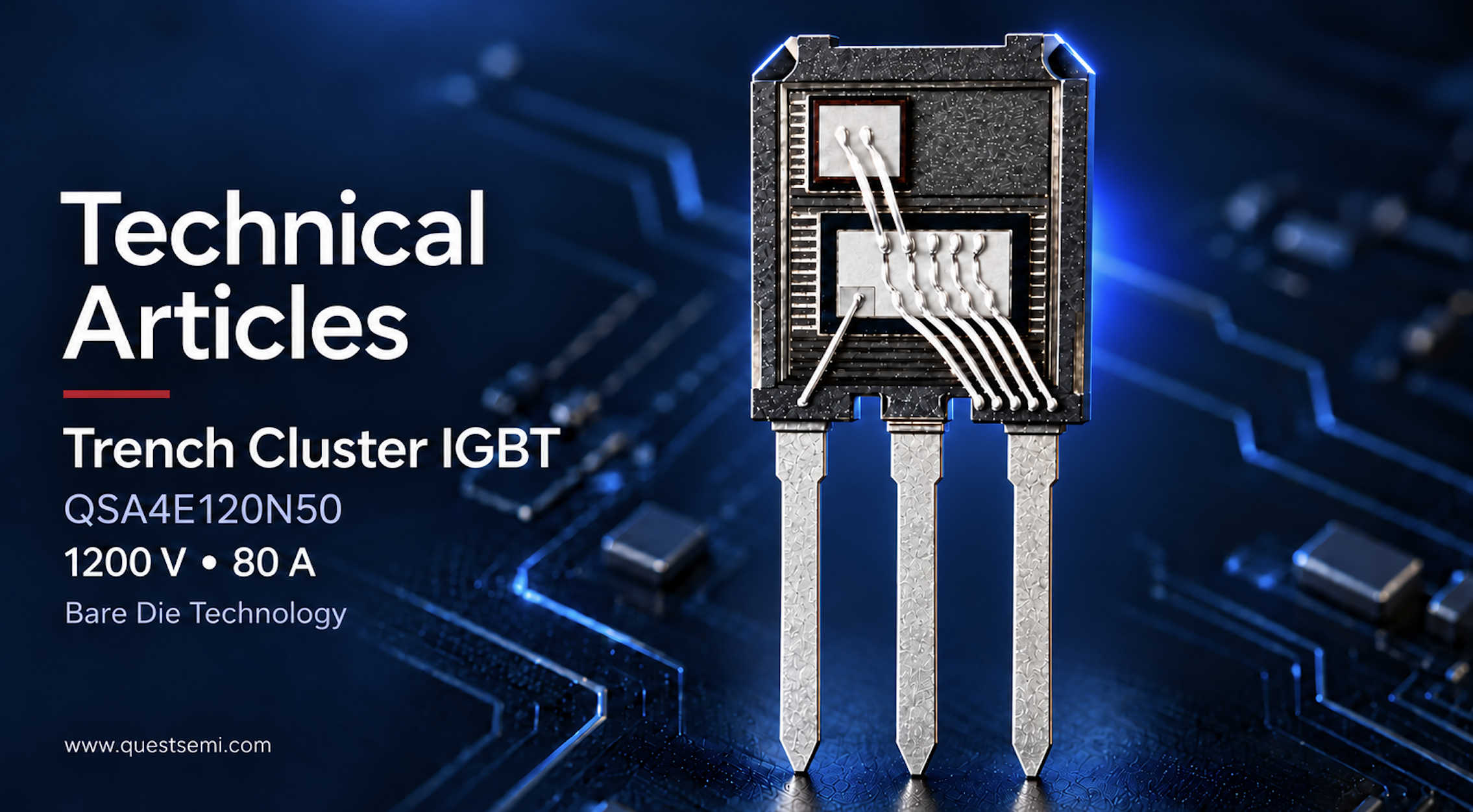
Trench Cluster IGBT: Five Key Advantages
Description
Trench Cluster IGBT (TCIGBT) technology combines trench-gate control with a clustered cell architecture designed to balance low conduction losses and controlled turn-off. Published University of Sheffield research demonstrates the following benefits compared with the conventional trench IGBT structures evaluated.
| Advantage | TCIGBT benefit |
|---|---|
| 1. Dynamic avalanche suppression | Self-clamping and hole-extraction mechanisms reduce local electric-field concentration during turn-off. Research demonstrates dynamic avalanche-free switching under the studied conditions. |
| 2. Low conduction losses | Enhanced carrier injection supports a low collector-emitter on-state voltage, helping reduce conduction losses. |
| 3. Improved turn-off control | Demonstrated gate-resistance control of turn-off dV/dt provides flexibility when balancing switching speed, electrical stress and interference. |
| 4. High-current-density capability | Research demonstrates or predicts avalanche-free turn-off at high current densities, supporting the potential for compact power-switch designs. |
| 5. Improved conduction–switching loss trade-off | The cluster architecture offers a route to balancing low on-state voltage with turn-off performance, rather than optimising either in isolation. |
Quest QSIG120N50 uses field-stop Trench Cluster IGBT technology, bringing this architecture to Quest’s power-semiconductor range.
View the Quest Trench Cluster IGBT product
Note: Trench Cluster and field-stop are not mutually exclusive—TCIGBTs can also use a field-stop layer. These advantages are research-supported design benefits, not guaranteed superiority over every commercial trench field-stop IGBT. Device-specific performance depends on operating conditions, packaging and validation.
